Catholics Against Architecture - Columns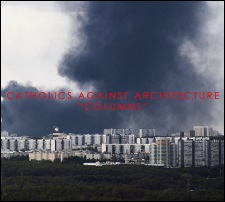 Chris Connelly has been prolific recently, and Columns is one of his most recent albums with his "new group", Catholics Against Architecture. It was recorded onto ancient reel-to-reel recorders and broken tape machines, many of them in various states of disrepair. This gives the album its distinct sound, harking back to early cassette culture and beyond. It sits somewhere between his Nico tribute and White Phosphorus his homage album to Throbbing Gristle, combining harmonium with a heavy use of industrial electronics. Chris Connelly has been prolific recently, and Columns is one of his most recent albums with his "new group", Catholics Against Architecture. It was recorded onto ancient reel-to-reel recorders and broken tape machines, many of them in various states of disrepair. This gives the album its distinct sound, harking back to early cassette culture and beyond. It sits somewhere between his Nico tribute and White Phosphorus his homage album to Throbbing Gristle, combining harmonium with a heavy use of industrial electronics. At its core, Columns focuses on the hypocrisy of religion, using the architectural columns of churches as a recurring image alongside the columns of smoke rising from destroyed cities. Throughout the album, missiles, war and conflict are repeatedly juxtaposed with the Crucifixion, drawing a line between religious violence and its modern equivalents. 'Nazareth Lodge' sets the tone immediately. Connelly arrives with commanding, almost Bowie-esque authority, his voice rising over archaic strumming, wavering electronic dissonance and ghostly harmonies. The track suddenly cuts to the clipped voice of a UK public-safety film warning, "don't take your child's safety for granted, accidents can happen". What follows is a scathing indictment of religious hypocrisy, with Connelly spitting out images of a "sanctuary for sadists" and the sickness surrounding unwanted babies. The track collapses into explosions, falling bombs and fragments of choir before Connelly slips into wordless wailing. It is a harrowing takedown of the behaviour of the Church. 'Blood In God's Water' initially opens with the drone of harmonium cast against shrill feedback, as Connelly's layered melodic voice emerges. As it unfolds, jazzy inflections arrive in the form of saxophone, alongside snippets of sermons from preachers and ministers. Connelly harmonises and tenderly sings, "can we be still and play between the droplets", before the mood turns more ominous with the line "we drowned under our own weight" carried onwards to the end in zither, percussion and improvised jazz. The stop-start clank of a tape-recorder button frames 'Braille', a faded, lo-fi recording of Connelly singing over harmonium. It sounds like a haunted fragment recovered from an old, dusty tape. 'Columns' begins with a low, industrial electronic buzz, while metallic scrapes and rattles gradually give way to harmonium. Connelly invokes the Eucharist alongside ash, coins and falling flesh, before arriving at the devastating image of a "stray bullet looking for a home". By juxtaposing columns with references to Columbine and lines such as "press the ash into a stone", the song takes on a contemporary resonance. The architectural columns of the church become indistinguishable from the columns of smoke rising from the bombing of modern day conflicts. Setting off from samples, the acoustic guitar and zither of 'Passage' provide a gentle folk ballad, while Connelly's phrasing carries traces of Bowie. The pastoral surface is offset by images of Catholic masses, deceit, faith, flesh and Crucifixion giving a more unsettling aspect to the warmth of the music. From a sample, 'Venomous Tenths' rumbles into industrial electronics as Connelly powerfully emotes and repeatedly insists, "no blood for blood". His voice sweeps over picked acoustic strings and discordant electronics, insisting, "do not you slither into torment without a fight", before being punctuated by hammering metallic pummels. 'Gates of Janus', meanwhile, layers news reports over low industrial electronics before giving way to an almost angelic hum, dreamy acoustic guitar and chiming tones. Connelly's poised, melodic vocals arrive, disrupted by echoed rhythms and tape manipulation. The title and some of the news reports point towards the Moors Murderers. A number of experimental tracks featuring spoken-word poems appear throughout. 'Altar' introduces the approach, with Connelly's lilting Scottish voice multi-tracked and treated with tape manipulation, electronics and samples captured from the same broken equipment used elsewhere on the album. 'Guided Angelus' is awash with samples and discordant electronics, while 'Evil He Fins' places his Edinburgh accent over jazzy horns and waves of discordant avant-garde guitars. The words become increasingly fragmented and disturbing, and none more so than in the turbulent industrial shriek and cavernous rumbling drone of 'Trade', filled as it is with images of arrows, asylums, skin falling away and drone-strike warfare. Together, these shorter pieces form part of the recurring theme, juxtaposing religious hypocrisy with modern warfare. 'Black Grail' provides the album's most brutally direct conclusion. Wailing, discordant electronics grind against an almost out-of-time pulse while Connelly's treated vocals are pushed towards a Whitehouse-like intensity. His words remain poetic, delivered as a roar, cutting into passages of collage made from layered news reports and documentary material concerning the Crucifixion, missiles and bombs. It is devastating and delivered with a precision that doesn't miss. As Connelly unleashes a tirade of images - starving faces, childhood flesh, blood spilled, intrusive metal - the connection between the nails of the Crucifixion and the missiles showering bodies with nails requires no further explanation. From a musician with a long history associated with Fine Tribe, Revolting Cocks and Ministry this isn't an easy listen. It's uncomfortable, it's questioning but Chris Connelly is still pushing forward experimenting, exploring sound and not afraid of tackling uncomfortable subjects. What began with the hypocrisy of the Church ends by drawing a parallel with the machinery of modern war. The columns of the title ultimately become something more than architecture: they are columns of smoke, destruction and history repeating itself. Columns is released on CD in a limited edition of 300 copies from Fourth Dimension Records |
Compulsion | PO Box 19577 | Kilbarchan |Johnstone | PA10 2WX | Scotland | UK


trawling the margins of (un)popular culture