Die Weisse Rose - The Evenings And Other Songs About Sex, Violence And Nihilism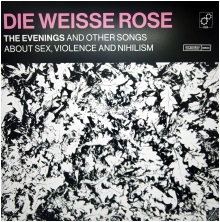 Not having covered much in the way of neo-folk, martial industrial or whatever over recent years, this arrived from Steelwork Maschine and I was intrigued by the stunning cover and title. Die Weisse Rose is the musical project of Thomas Bøjden, and on this, the first studio album from Die Weisse Rose in 17 years, he is joined on piano by Cornelius Waldner of Sagittarius and violinist Aloma Ruiz Boada, who performed with Current 93 on The Light Is Leaving Us All and If A City Is Set Upon A Hill. Together with Bøjden, they incorporate field recordings, samples and harmonium into the album's sound. Not having covered much in the way of neo-folk, martial industrial or whatever over recent years, this arrived from Steelwork Maschine and I was intrigued by the stunning cover and title. Die Weisse Rose is the musical project of Thomas Bøjden, and on this, the first studio album from Die Weisse Rose in 17 years, he is joined on piano by Cornelius Waldner of Sagittarius and violinist Aloma Ruiz Boada, who performed with Current 93 on The Light Is Leaving Us All and If A City Is Set Upon A Hill. Together with Bøjden, they incorporate field recordings, samples and harmonium into the album's sound. I'm not familiar with Die Weisse Rose and don't know how it compares to their previous releases, but it follows the precedent of Current 93's Soft Black Stars and Death In June's Peaceful Snow in its piano-based approach. Much of Bøjden's lyrics seem cut from the same cloth as Douglas P.'s words, and the album does share an affinity with many of the genre's touchstones. However, the group's support for Ukraine - the album is dedicated to Ukraine - and the fact that some songs deal directly with Russia's invasion give it a very different context. The press notes introduce the album with: "A world on fire. A journey through its embers. A demand that art must turn into action," and describe it "as a sonic and poetic documentation of a world that is aflame." The opening piece 'With God On Our Side' immediately establishes the album's tone. Furnished with broadcast samples over sombre piano, Thomas Bøjden's deep, measured voice, shadowed in mournful violin, speaks less as a singer than as a witness. Lines such as "through the mess, the turmoil of a world that is burning" carry tremendous weight, while the repeated image of letting go, leaving "wet with goodbyes" encapsulates the album's quiet grief and melancholy. 'The Length Of Your Body' continues this atmosphere, its violin leading through layers of sampled ambience, while the brief 'Youth Beauty Death' is devastating. Lasting only moments, its stark declaration that "Death comes easy when you are young" is delivered as lived experience rather than poetic flourish. 'The Evenings' is one of the central tracks to the album. Unfolding over exquisite melancholic piano and weeping violin, its reflective spoken narration contemplates the passage of time and of life's struggles. The line "from open graves, this year a row of coffins" is delivered without theatricality, furthered by its ask of "do not grieve" making it all the more affecting, before it concludes in a verse of defiance. A rare glimpse of tenderness appears in 'The Impossible Love'. Field recordings of rainfall, hopeful piano and graceful violin accompany a spoken recollection of physical intimacy. The yearning here is less about fulfilment and more about humanity's enduring search for beauty amid devastation. More devastation appears on the haunting 'Sleep Lübeck Sleep', which may be the album's most haunting composition. Amid minimal piano notes, harmonium and suspended violin Bøjden repeats the title before the striking image of "it's like Caravaggio dust falling, in those Bambi eyes". Perhaps a metaphor for the dust and desolation, and destruction of a city devastated by war. Perhaps not, but as he repeats the title again and piano notes ebb the violin remains almost frozen in time. 'Our Eternal Summer'opens the second side to the distant sound of children playing and introduces perhaps the record's most poignant contrast. A gentle piano score accompanies Thomas Bøjden's reflections upon youth and longing for a more innocent time. The closing resonant piano chords points to a more austere end fading out to the sound of lapping waves. Draped in reverbed chattering sample the minimal piano and violin score of 'Lifeflowers And Liferunes' captures a yearning in the lyrics delivered in heavy set enunciated tone, while on 'Runaway Horses' Boada's violin score scrapes and weaves amid tumbling piano notes as Thomas Bøjden asks "who will ride your wild horses, who will ride your wild runaway horses" perhaps reflecting a world spinning out of control. 'Perfumed Malevolence' explicitly reconnects with the symbolism of the White Rose. Bøjden's commanding narration rides above the piano score, later accompanied by a jaunty folk-inflected violin. References to lilies and petals offer images of beauty while the blossoming of petals to become white roses of the final line a reminder of the blooming of resistance and to the original German resistance group. The closing two tracks form an extraordinary conclusion. 'Ukrainian Sun' emerges from hollow chimes and a ghostly mass of choired voices creating an archaic atmosphere as it segues into '(We All Are) February 24th', the final piece, to the sound of trains rolling across tracks. Here broadcast fragments surface amid piano score and slowly ascending violin accompanying narration that moves between eyewitness testimony and self-examination. Images of soldiers kneeling in a church, and embraces from mothers of children who are not their own. Bøjden poses the repeated question "Who am I, what have we become?" transforming the song into something that is both memorial and indictment. As piano ebbs out and the clatter of trains disappear into silence, this could maybe be considered as a 'Heaven Street' for the 21st century. Drawing upon a sparse palette of piano, violin, harmonium, field recordings and spoken word The Evenings And Other Songs About Sex, Violence and Nihilism is an exquisitely performed album of restrained power, reflecting upon humanity's capacity for love and cruelty, finding moments of beauty amid grief, remembrance and resistance. It unfolds like a meditation on memory, love, war, beauty and mortality. The Evenings And Other Songs About Sex, Violence and Nihilism is released on vinyl in an edition of 500 with 250 on black vinyl and 250 on pink vinyl from Steelwork Maschine |
Compulsion | PO Box 19577 | Kilbarchan |Johnstone | PA10 2WX | Scotland | UK


trawling the margins of (un)popular culture